Pages

Monday, October 14, 2013

Saturday, December 4, 1971: Isle of the Dead (1945) / Cry of the Werewolf (1944)


Synopsis: During the First Balkan War of 1912, General Nikolas Pherides (Boris Karloff) punishes one of his subordinates in the Greek army, an officer whose troops arrived late to the front during the battle that has just concluded.  Despite the officer’s protests, and despite the battle's evident success, Pherides strips him of rank and gives him a pistol, allowing him to commit suicide.  This cold-blooded behavior is questioned by American war correspondent Oliver Davis (Marc Cramer). But Pherides replies that what might seem like cruelty is simply grim necessity.  War, the general says, does not allow for mistakes or excuses. He notes that the punished officer was an old friend of his.  


Walking outside with Davis, Pherides points out the men who are hauling bodies from the battlefield on a cart.  They are working late into the night, the general says, because the bodies must be disposed of immediately.  Cholera and septicemia are constant hazards on the battlefield. Once diseases of that kind begin to spread, there is little to stop them, and they can quickly wipe out a fighting force.

The general mentions that his own wife died many years ago, and that she is buried in a crypt on a nearby island, an island that serves solely as a cemetery.  The two decide to go and visit the grave, and they take a rowboat over to the island.  But the general is distressed to find that his wife’s grave has been desecrated; in fact all the coffins in his wife’s crypt have been broken into, and now the bodies are missing.   The two are about to return to the mainland when they hear a woman singing a haunting melody.  This surprises both men, since they were unaware that anyone else was on the island.

Following the singing, they find a number of people at the caretaker’s house. Albrecht (Jason Robards, Sr.) is an archeologist whose work on the island years ago incited the locals to desecrate graves in search of valuable antiquities. Mortified, Albrecht retired from his profession and has been living on the island ever since, having bought the caretaker's house from Madam Kyra (Helene Thimig).

Also staying on the island during the fighting on the mainland are St. Aubyn (Alan Napier), his wife,  the ailing Mary (Katherine Emery), and the nervous Mr. Robbins (Skelton Knaggs).  There is also Thea (Ellen Drew), a lovely young woman whose singing drew the men to the house.


Madam Kyra is convinced there is evil afoot in the house, and she draws General Pherides aside to tell him that she suspects the presence of a "vorvalacka"  -- a supernatural being that suffuses itself with life by draining the health and vitality of those around it.  Pherides laughs off this suggestion, telling her that he is too old to believe such stories.

Davis wants to stay overnight in the caretaker's house, as he hasn't slept in a real bed in months.  Though he doesn't mention it, he'd also welcome the opportunity to get to know Thea better.  Pherides reluctantly agrees, figuring that he'll be able to inspect the shore artillery at first light on his way back to camp.  However, during the night Mr. Robbins dies.  Knowing that Robbins' symptoms are consistent with an outbreak of septicemia, Pherides summons the camp physician.  Sure enough, Robbins is declared to have been killed by the plague.  This means that the islanders are quarantined, and no one can come or go from there, including the camp doctor, reporter Davis or Pherides himself.

One by one, those on the island fall to the plague.  Madam Kyra insists that the deaths on the island aren't caused by plague, but by  the vorvalacka.  And Pherides, that practical, world-weary man of facts and reason, begins to wonder if perhaps she is right. Maybe the sinister being exists after all, and maybe it is none other than  the beautiful Thea herself, who remains the very picture of health even as those around her are dying of the plague....


Comments:  Isle of the Dead is the first Val Lewton film to be broadcast on Horror Incorporated, and while it is considered to be one of Lewton's lesser works, it perfectly captures why his movies have had such an impact on audiences through the years.  Lewton's approach to horror is unique. His movies are atmospheric,  lyrical, almost dreamlike in the way they unfold.  Their themes tend to be existential: death is always lurking just off-camera, and -- inevitably -- something beyond death too.

The title, as well as the haunting image of the island itself, is taken from a famous 19th-century painting by Arnold Bocklin.  The painting depicts an island enclosed by forbidding stone cliffs.  Towering cypress trees -- strongly associated with cemeteries -- grow in the island's center. A boat is being rowed to the island seawall; a hooded figure in white stands in the bow, just behind a white object which is usually interpreted as a coffin.

Lewton was both frightened and fascinated by the painting as a child and he clearly wanted to make a film that captured its aura of mystery.


The plot moves forward in a leisurely way, slowly building a sense of dread rather than trying to shock or terrify the audience.  This tactic actually works quite well; we are inevitably drawn quite skillfully into the movie's reality.   Lewton is forced to depend on a keen eye rather than a big budget to render its carefully-constructed verisimilitude. With a few historical references and modest costumes, he manages to convincingly set his film in the midst of the First Balkan War (all the scenes are shot on fairly small soundstages, and the distant view we have of the island is a matte painting).   There are, in fact, only 11 speaking roles in the film. 

Lewton's protagonists tend to be practical and fairly unimaginative people,  who are drawn unwillingly into the world of the strange and the supernatural. In Cat People, a nautical engineer marries a foreign woman with a deadly family curse; in I Walked With a Zombie a nurse finds herself mixed up with black magic when she takes a job in the Caribbean; and in Isle of the Dead a battle-hardened general comes to believe in the fearsome vorvalacka .

Interestingly, the success of Lewton's signature style had no impact whatsoever on the way his films were sold.  If you were to judge by the marketing materials, Karloff plays just another glowering nut.  "ABANDON ALL HOPE!  FOR THIS IS THE ISLE OF THE DEAD!" the trailer screams. "RULED BY BORIS KARLOFF....WHO SEALS THE DOOM OF ALL WHO DARE ESCAPE!"

Of course Karloff's character isn't at all what the trailer leads you to believe. He isn't a lunatic, doesn't "rule" the island, and he isn't sealing anybody's doom -- in fact, he forbids the others from leaving the island in order to prevent the plague from spreading.

  Lewton had pretty much cornered the market on this sort of atmospheric fare since he was named the head of RKO's horror unit in 1942.  His first project was Jacque Tournier's Cat People in 1942, a low-budget hit that gave him a remarkable amount of creative freedom with the studio.


In spite of the catch-penny titles (I Walked With a Zombie is guaranteed to trigger a snort of derisive laughter from those who haven't seen it) these films are quite sophisticated, and Karloff always seemed grateful to have appeared in this film as well as Lewton's Bedlam and The Body Snatcher.  It's tempting to say that Val Lewton's early demise cut short his career  (he died in 1951, at the age of 46) but the last of his influential cycle of films came some five years earlier.  But he left behind a remarkable body of work, absolutely unlike that of any other horror producer.


Cry of the Werewolf


Synopsis: Dr. Charles Morris (Fritz Leiber) operates a museum of the occult, located in the former mansion of a famous Gypsy queen named Marie LaTour.  Dr. Morris tells assistant Elsa Chauvet (Osa Massen) that he is about to publish a ground-breaking work on Marie LaTour, which will reveal important new information about her life.  

Elsa leaves to pick up Dr. Morris' son Bob (Stephen Crane) at the train station, but when the two of them return to the LaTour mansion they find Dr. Morris has been killed by an animal - apparently a wolf.  Moreover, the notes he has compiled for his manuscript have been tossed into the fireplace and are mostly burned, and a tour guide who was present at the museum is now babbling incoherently, his mind apparently broken by what he witnessed.


Bob and Elsa devise a way to reconstruct some of the information from the burned notes, and this leads them to investigate the mythology and practices of the Gypsies.  Marie LaTour had purportedly been a werewolf, and as the Gypsies are a matriarchal society, her daughter -- also named Marie LaTour -- has inherited her lycanthropy.
 
Meanwhile, Lt. Barry Lane (Barton McLane) doggedly tries to solve the murder without resorting to occult explanations.  This is surprisingly difficult, since Elsa, his first prime suspect, is cleared because her fingerprints don't match those found at the scene of the crime, and museum janitor Jan Spavero, his second prime suspect, ends up getting mauled by a wolf....
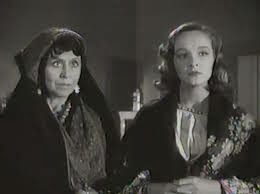


 Comments: After our sojourn to Val Lewton's island, we're now back in familiar ground with Columbia's Cry of the Werewolf.  This is the third broadcast of the movie on Horror Incorporated, and it has been firmly relegated to second-feature status.  It's relatively low-octane stuff, with the shocks and special effects kept to a minimum. The same could be said, of course, for Isle of the Dead, but the creative decisions made in that film were  in service to the plot.  Here, they appear to be due to  a lack of both money and imagination.

Columbia had never shown much interest in the horror genre, aside from a string of standard-issue mad scientist pictures written for Boris Karloff in 1939 - 1940, when he was under contract with the studio. Lew Landers' Return of the Vampire came along a few years later, and was an obvious homage to the previous decade's Universal horror films.  It was the success of that film that paved the way for Cry of the Werewolf.


Unfortunately,  Cry of the Werewolf  lacks a few things that were present in Return of the Vampire.  We have neither a strong protagonist nor antagonist.  Instead of the Van Helsing-esque Lady Ainsley, who had been played with great verve by Frieda Inescort, our attention is split between Ona Masson as Elsa Chauvet and Stephen Crane as Bob Morris.  Masson, it should be said, is an engaging actress.  The trouble here is her character is almost entirely passive: her main function is to moon over the painfully dull Bob.  

As for an antagonist, there isn't a Bela Lugosi in sight. Instead we get Nina Foch, who did well enough as young Nicki Saunders in Return of the Vampire. But she is miscast here, pressed  into service as gypsy queen Marie LaTour.  She is a bit young for the part,  distinctly lacking in gravitas and never comes across as much of a threat, despite her ability to change into a wolf.  You'd think that would establish her badass bona fides, but somehow Foch seems like a rather perfunctory villain. 

Saturday, September 28, 2013

Interlude: All-Star Video


You may have noticed the presence of All-Star Video in the blogroll. In case you haven't checked it out, All-Star Video is a site run by John Moret, who like me is a volunteer at the Trylon Microcinema in Minneapolis.  John writes about movies with the manic enthusiasm of a motorcycle stunt driver, and he has an encyclopedic knowledge of obscure horror titles from the 70s and 80s (I believe my first extended conversation with him was about the horror opus Devil Times Five.)  He also has a podcast that stands in part as a kind of oral history project, talking to people who do interesting film-related stuff: not just  filmmakers, but exhibitors, programmers and writers. 

John's too young to remember Horror Incorporated, but he's a faithful reader of the blog.  Recently he asked me to sit down with him and record an interview about the Horror Incorporated Project, TV in the 1970s,  the future of curated content, how to get fired from your job in a home video store, and some other crazy stuff.  It was really a kick for me to do it, especially since he's  previously interviewed some very interesting people, such as the Heights Theater's Tom Letness, Trash Film Debauchery's founder Theresa Kay and the Trylon's shihan Barry Kryshka.  You can hear the interview at the All-Star Video site.

John's also a film exhibitor, and he has an inspired event coming up on Wednesday, October 2: the Spanish-language Dracula will be shown at (and as a benefit for)  the Pioneers and Soldiers Cemetery in Minneapolis (the one at the corner of Lake and Cedar).  Tickets are $5 and you can find out more here.

John's screening will also kick off Take-Up Production's Universal Horror series in October, which features a number of titles I've written about on this site.

Thursday, September 26, 2013

Saturday, November 27, 1971 (Midnight): The Beast With 5 Fingers (1946) / The Return of Doctor X (1939)


Synopsis: Bruce Conrad (Robert Alda) is an American living in a small Italian village.  He makes a living partly by fleecing American tourists with "antique" stones, and partly by ingratiating himself to Francis Ingraham, a wealthy musician who owns a mansion in the village.

Ingraham is in poor health, confined to a wheelchair, and he only has the use of one hand.  As a concert pianist this is immensely frustrating for him.  But Conrad, himself a musician, has composed for him a number of pieces that can be played with one hand, something which gives Ingraham some measure of comfort.

One evening Ingraham asks his nurse Julie, his long-time secretary Hilary (Peter Lorre), his attorney Dupreix and Conrad to join him over dinner.  He asks each of them if they consider him to be of sound mind, and they all agree that he is. He then asks them to sign a document naming them witnesses to a new will that he has written.

It is clear that Ingraham is in love with Julie.  So is Conrad; and he tries to convince Julie to come away with him, even though he knows that he has no money and no prospects. Ingraham, he admits ruefully, is the meal ticket for all those around him.  Conrad lives off his largesse; Julie is on his payroll, as is Hilary; and there's no doubt that Dupreix depends on Ingraham for much of his business.

But Hilary has overheard Conrad's conversation with Julie, and he immediately goes and tells Ingraham about it.  Ingraham, thinking that Hilary is trying to turn him against Julie, seizes Hilary's throat, choking him.  Hilary manages to escape, but is left with ugly marks on his neck.  Ingraham tells him to get out of the house.


Late that night there is a tremendous thunderstorm, and Ingraham, calling in vain for Julie, brings his chair too close to the top of the stairs.  The wheelchair tips and Ingraham takes a fatal fall down the long staircase.

The discovery of the body is a great shock to the community, and soon Ingraham's only living relatives show up --  Mr. Arlington (Charles Dingle) and his son Donald (John Alvin). The two immediately start taking an inventory of the house's contents, clearly with the idea of liquidating them. This angers Hilary, who claims all the books in the library belong to him, that they were gifts from Ingraham.

But when the will is read everyone is shocked to discover that Julie has been named as the sole heir.  The Arlingtons are furious, and vow to contest the will.  Dupreix secretly meets with the Arlingtons and agrees to support their claim in exchange for a cut of the estate.

But weird things start to happen. There's a light coming from the crypt where Ingraham is buried.  Dupreix opens his door to discover a hand -- bearing Ingraham's ring -- reaching for his throat; he is later found strangled. The piano downstairs is heard to play one of Ingraham's one-handed compositions, but when people go to investigate no one is there.  Later, Hilary swears he saw Ingraham's disembodied hand moving of its own accord.  Arlington is nearly strangled by a hand that seemed to come from nowhere.  And when  police commisario Castanio leads the others to the crypt they discover that Ingraham's hand has been cut off from his body, and a window in the crypt has been smashed -- a window just large enough to allow a human hand to escape....


Comments: We have an unusual double bill tonight: back to back horror films from Warner Brothers.  Warner ventured into the horror genre only rarely, so the odds of getting two in a row are pretty unlikely.  There's no way to tell if it's by accident or design.  Either way, it's a nice change of pace.

First up is The Beast With 5 Fingers, a Curt Siodmak-penned thriller about a crawling hand on the loose in a spooky mansion.  The central mystery of the film -- whether the crawling hand is real or a delusion -- doesn't detract from the general aura of creepiness, and it should come as no surprise that this film was directed by Robert Florey, whose movies were always atmospheric, if nothing else.

The movie takes its time getting started, but that's not a bad thing. This isn't a typical smash-and-grab programmer, as time and care are taken in establishing each of the characters.  And each character, we learn, has his or her faults, even our protagonist  -- something else you don't often see in genre films. Bruce Conrad is affable, charming, and intelligent, yet he seems keenly aware of his own weaknesses and failures.  He has wound up in this quaint Italian village due to his own mistakes, but seems to have no idea how to get out.  He loves Julie and wants to start some kind of life with her, somewhere (or so he claims)  but seems paralyzed.  He is just as adrift without Ingraham's patronage as he was with it.

It is amusing that Julie, who had confessed previously that she wanted nothing more than to get away from Ingraham's gloomy mansion, is determined to stay once the will is read.  Bruce acts shocked, as though this is some sort of betrayal, and in a sense it is.  In death Ingraham has a power over her he never had in life. After all the 10-lire-per-game chess matches Bruce conned Ingraham into playing, he seems surprised to have been checkmated so easily himself.

Peter Lorre gives his standard manic, bulgy-eyed performance, in a role that had originally been offered to Paul Heinreid. I wouldn't say that Lorre is particularly good in this movie, but he could certainly make a convincing hysteric.


One of my favorite Universal contract players, J. Carrol Naish, portrays police comissario Castanio with a great deal of verve, even though the character is a thinly-written ethnic type.  Naish always managed to inject a bit more good humor and warmth in such roles than what could be found on the page, and he's delightful to watch here.

Max Steiner composed the eerie score, and he really outdid himself: this is terrific film music.  The one-handed piano compositions, it should be noted, were by Brahms.  Steiner chose them specifically for their slightly unnerving feel, and they are perfectly appropriate for this film.

The Beast With 5 Fingers comes from a time when horror films were tilting toward explained-away endings, and from a studio that was keenly embarrassed by genre material.  So it's not surprising that this horror effort hedged its bets to the extent that it did.  Nevertheless, it's a smart and entertaining attempt to make a serious and literate horror film.


The Return of Doctor X


Synopsis: Newspaper reporter Walter "Wichita" Garrett (Wayne Morris) is thrilled to score an interview with celebrated actress Angela Merrova (Lya Lys).  But when he arrives at her apartment, Garrett finds Merrova dead, stabbed through the heart. Like any good newspaperman, he calls not the police, but his editor.  Before you can say "stop the presses!" his newspaper blares this scoop on its front page.  It's only after the late edition comes out that the police find out about the crime and arrive at Merrova's apartment, but they find no body, and no sign of a struggle.  Garrett is perplexed, but insists that Merrova is dead and someone must have moved the body.

Later, Garrett is called into his editor's office, where he is astonished to find Angela Merrova, not only alive, but threatening a monster lawsuit.  Garrett insists that he saw Merrova dead, and that this woman must be an imposter. The editor sees things differently and Garrett is fired. But because he is that plucky breed of newspaperman that we often encounter in old movies, this doesn't deter him.  He seeks out his friend, Dr. Michael Rhodes (Dennis Morgan) to ask him whether someone with a stab wound of the type Angela Merrova sustained could survive. 

The good-natured Dr. Rhodes is tolerant of Garrett's questions but he's a little busy.  He is preparing to assist hematologist Dr. Francis Flegg (John Litel) with a tricky blood transfusion.  The donor, a man with a rare blood type, hasn't shown up.  Nurse Joan Vance (Rosemary Lane) tells him that she has the same rare blood type, and volunteers to take the donor's place for this procedure.


Joan clearly has a crush on the handsome Dr. Rhodes, and volunteering for a transfusion succeeds in catching his attention: after the procedure asks her out on a date.  But instead of dancing under the stars, she ends up tagging along as Rhodes and Garrett check up on the missing blood donor.  They find him dead in his apartment, his body drained of all blood.  In fact the only blood they do manage to find doesn't seem to be human blood at all.

They take the blood sample of Dr. Flegg, but Flegg seems rattled by it, angrily asserting that it's ordinary human blood.  While there, they meet the doctor's creepy assistant Marshall Quesne (Humphrey Bogart), a pallid man with a streak of white running through his hair. Certain that he's seen Quesne somewhere before, Garrett searches the newspaper archives until he stumbles onto the photograph he's looking for: Quesne is none other than Dr. Maurice Xavier, whose diabolical experiments sent him to the electric chair years earlier.  Garrett now knows of two dead people who have turned up alive.  But how is it possible?


Comments: Like Return of the Ape Man and Devil Bat's Daughter, The Return of Dr. X  is a bit of a cheat in that it isn't a sequel at all.  There's absolutely no connection between this movie's Dr. Xavier and the one portrayed by Lionel Atwill in Dr. X.

However, The Return of Doctor X isn't nearly as bad as those two non-sequels.  It's a hybrid of horror and science fiction that's only remarkable for two things:  the fact that it was produced by Warner Brothers (which seldom ventured into the horror genre) and the unlikely presence of Humphrey Bogart, who plays the character of Quesne from beneath a thick layer of makeup and a prominent shock of white hair.

Bogart rarely talked about this movie, and when he did he had nothing good to say about it.  He had appealed to Jack Warner to let him out of the assignment, but he was not yet a big enough star to choose his projects and in the end he had to go through with it.  "You can't believe what this one was like," he said later.  "I had a part that Bela Lugosi or Boris Karloff should have played".  In fact the role had been written with the latter in mind, but by the time The Return of Dr. X  went into production Karloff's three-picture deal with Warner had already been fulfilled.  Somebody had to play the role, and without any established horror stars on the lot Bogart ended up with the job. It would prove to be the only horror film of his career.

To his credit Bogart carries on gamely, but he wasn't kidding. This isn't his kind of picture. He comes off like a weirdo in his introductory scene, stroking a white rabbit and peering out from behind a pair of coke-bottle specs, but he can't project the vague sense of unease that you get from Boris Karloff or Vincent Price. There's no real menace behind the character, and as a result the whole movie seems rather slack and perfunctory.

Wayne Morris is ostensibly the lead as the dogged reporter, but he's a little too goofy-looking to be a leading man, and his character is awfullly light-hearted for a horror film.  Then again, most of the newspaper reporters we've encountered on Horror Incorporated have been there mostly for comic relief, or (like Wallace Ford in Night of Terror) have been cheerful blue-collar types, able to see through the bluster of the croquet-and-cucumber-sandwich crowd .  By contrast, reporters in crime dramas have been much more hard-bitten types.

Dennis Morgan is the more conventional leading-man type, and he dutifully checks the movie-romance box with Rosemary Lane's adoring nurse character.  But the romantic subplot doesn't really go anywhere; in fact, Dr. Rhodes hardly seems interested in her at all.  The word "bromance" hadn't been coined yet, but there seems to be a lot more fun to be had hanging out with the reporter at the morgue than taking some stupid girl to a dance. And let's be honest: Rosemary Lane is sweet as apple pie.  But in a noirish thriller, what you're really hoping to meet is a femme fatale.  And the sad truth is that in this film, there isn't a bad girl to be found.


Thursday, September 12, 2013

Saturday, November 20, 1971 (Midnight): The Ape (1940) / The Brighton Strangler (1945)

Synopsis: Dr. Bernard Adrian (Boris Karloff)  is widely disliked by his small town neighbors. The locals have few rational reasons for their dislike. Dr. Adrian keeps to himself, but he is civil enough.  Nevertheless there is a general feeling that doesn't belong, and the distinctly vague complaint that he "experiments too much".

The one person in town who adores Dr. Adrian is Frances Clifford (Maris Wrixon), a young woman stricken with polio.  Dr. Adrian dotes on her like his own daughter, and this causes resentment from Frances' jealous jerk of a boyfriend Danny (Gene O'Donnell).

Dr. Adrian has been experimenting with the spinal fluid of animals, and he believes he is getting closer to perfecting a serum that will cure those who've been stricken with polio.  At about the same time, a circus comes to town, and Dr. Adrian encourages Danny to take Frances to see it.  Late the same night, an ape badly injures its trainer and escapes from the circus.  The trainer is brought to Dr. Adrian's surgery, but it is clear that the man has little chance of survival.


Soon Dr. Adrian has created a human serum and he begins to treat Frances with it.  The serum causes great pain to her legs, which alarms Danny, but Dr. Adrian sees this as an encouraging sign, since the paralysis had left her without any feeling in her legs whatsoever.  Meanwhile, the ape, which is still on the loose, kills another man, and Dr. Adrian must sign the death certificate.

Frances' reaction to the spinal fluid treatment is encouraging.  While the pain in her legs is growing worse, she is able to move her foot a little -- a clear sign that Dr. Adrian's treatment is working.

Late one night the ape breaks into Dr. Adrian's lab.  Dr. Adrian is able to kill it but not before it smashes his vials of serum. He decides to keep the ape's death a secret.

Soon the county coroner comes to visit Adrian.  It seems the two victims of the ape were both found to have puncture wounds in the spine -- as though Dr. Adrian had injected something into the men -- or extracted something.

Before long, Dr. Adrian is topping up his spinal fluid supply by wearing the ape's skin and murdering those who mocked his work....


Comments: Small-town people do not come off well in Hollywood movies of this era.  Like other horror films from the 1940s -- The Spider Woman Strikes Back, The Man Who Returned To Life and The Devil Commands among them -- small-town folk are depicted in The Ape as a bunch of peevish, paranoid busybodies. There is no reason, really, that anyone should dislike the kindly Dr. Adrian. But of course it's convenient to the plot that they do, because it gives Dr. Adrian an excuse to turn against them and....um....wear an ape's skin around town and.... brutally kill people so.... um....so that he can draw spinal fluid from their corpses....

Aw, I give up. You just can't talk about this movie without banging your shins against its absurd plot points. In the end you just shrug and mumble to yourself, "It's Monogram, Jake. Forget it". Like our last Monogram entry, Return of the Ape Man, this one casually tells an increasingly idiotic story, almost daring you to give up on it.

Working in the film's favor is Boris Karloff,  much more adept at carrying a bad movie than Lugosi  (Karloff is better at carrying good movies too). It's pretty much a standard Karloff mad-scientist picture of the era, albeit somewhat dumber (and a lot chintzier) than the Columbia pictures he'd only recently starred in. 

The screenplay was co-written Curt Siodmak, very loosely based on a 1927 stage play.  Siodmak was already nursing his pet obsession with swapping out brains and brain fluid and so forth. In spite of his one-track mind Siodmak was a decent screenwriter, workmanlike if nothing else, but he doesn't come across very well here.  Monogram wasn't the sort of studio where much care was taken with any aspect of the production, least of all the script; and we have to presume that the first draft of this clunker was good enough for producer Scott Dunlop.

The Brighton Strangler


Synopsis: Celebrated actor Reginald Parker (John Loder) has just completed a successful run on the London stage with the hit play The Brighton Strangler.  The theater manager ruefully notes that he could easily run the show for another year, and he's sorry that Parker has decided to hang up the role.  So arresting is Parker's performance that there's no thought of bringing in another actor to play author-turned-murderer Edward Grey.  For audiences Parker is the Strangler.

It is December 23rd, and after wishing the cast and crew a happy Christmas, Parker prepares to leave the theater and rejoin his wife, who is also the author of the play.  But German bombers are making a nighttime raid on London.  Numerous bombs hit the neighborhood and the theater is destroyed.  Parker staggers away from the ruined building.  He's gotten a nasty knock on the head and he is in a daze.  Has he forgotten who he is?  Not exactly; he remembers that he's Edward Grey, and he heads to Victoria Station and buys a ticket to Brighton.


At the station he meets beautiful young April Manby (June Duprez), a WAAF heading home for Christmas.  Seeing that Parker -- or rather, Grey -- is injured, she helps daub a bit of blood off his forehead.  On the trip to Brighton she confides in him that she has secretly married her sweetheart, an American soldier named Bob Carson (Michael St. Angel).  Upon arriving, April is met by her parents, respected physician Dr. Manby (Gilbert Emery) and his wife (Lydia Bilbrook). They invite Grey to come over and celebrate Christmas Eve at their house the following evening.

The next night, Grey leaves his hotel room and walks to the Manby house.  Along the way he encounters the mayor of Brighton, Herman Brand (Ian Wolfe).  Grey accuses the kindly mayor of being the barrister who had betrayed him -- a charge which puzzles Brand but which we know is taken from the play The Brighton Strangler.  Reaching into his pocket, Grey produces a silk cord, which he'd kept in his pocket after the show closed. He uses the silk cord to strangle Brand, and then proceeds to the Christmas party as though nothing has happened.

Late that evening, Chief Inspector Allison (Miles Mander) arrives at the Manby house.  Everyone is shocked to hear of the murder of the mayor. The following day, the police interview all new arrivals in town, including Grey.  Like the character in the play, Grey is outwardly pleasant and charming.  He says that he is staying in town to write a book, and that he is a friend of the Manby family.  Soon he is crossed off the list of suspects.

April is surprised to learn that Bob is able to join her in Brighton for a few days.  But because of the mayor's funeral, she isn't able to meet him at the station, and she asks Grey to meet him for her.  Grey meets Bob, and takes him over to the hotel.  But as Bob checks into his room, Grey goes to his own room and falls asleep.    He dreams that he is confronting Inspector Allison, who is now another of his persecutors from the play. 

As Bob goes over to his new friends's room to knock, he overhears Grey talking angrily in his sleep -- vowing revenge, and threatening to kill an unseen someone....


Comments: There's something inherently nutty about actors. They tend to be rootless types who spend their days crying and emoting and otherwise pretending to be people they aren't. And while Reginald Parker isn't a Method actor, he is so wrapped up in his fake life that he's only one knock on the head away from trading it in for his real life.

This is the sort of premise that could easily descend into self-parody, and as a result the screenwriters are careful not to portray Parker as a guy obsessed with the role he plays.  As the movie opens we're told that Parker has chosen to stop playing the Strangler on stage, even though the show is a hit.  Acting might be his profession, but he isn't a weirdo about it -- he has a real life offstage.  He is a loving and attentive husband, and he looks forward to collaborating on other projects with his playwright wife.  He is unfailingly kind and courteous to everyone on the cast and crew, and we accept that his success hasn't turned him into a boor or a megalomaniac.

Once his credentials as a nice, well-adjusted person are established (see, he's not like an actor at all!) we get to the bombing raid that drops part of the roof onto his head.  The is actually a great device, much more dramatic than if he had fallen off his bicycle or walked into a lamppost, but the wartime setting also presents a risk: wartime pictures look dated just as soon as the war in question is over.  I imagine the producers were sweating bullets about that, wondering if the war would end before their movie was released.  In fact The Brighton Strangler was released before the end of the war, but just barely,  in April of 1945.

 As unlikely a premise as this is, The Brighton Strangler is a pretty good little thriller, helped enormously by the presence of John Loder as Reginald Parker / Edward Grey.  Loder has an easygoing charm that puts us on his side, and although he doesn't quite pull off the deranged serial killer bit (he was a bit too wholesome-looking to come across as dangerous) he's still required to carry a lot of the film himself, and he does.

The lovely June Duprez brings us a very self-assured April Manby, and Miles Mander is quite likable as the ill-fated Inspector Allison. Ian Wolfe shows up -- he seems to have been born elderly -- as the town mayor, and Michael St. Angel has some funny scenes as the all-too-American Bob, who keeps his British hosts baffled by a never-ending stream of American slang -- "skip it", "juke joint","on the nose", "don't snap your cap," etc. But amusingly St. Angel is evidently British -- at one point he tells Parker / Grey "I'll ring you up", a Britishism that no American could have delivered with a straight face. Who's the phony now?


Saturday, August 24, 2013

Saturday, November 13, 1971 (Midnight): Svengali (1931) / The Devil Bat's Daughter (1946)


Synopsis: The eccentric musician Svengali (John Barrymore) ekes out a living as a music tutor in Paris. He lives a decidedly bohemian lifestyle: he rarely bathes, his clothes are worn and unkempt, and he owes money to just about everyone he knows.

Svengali is acquainted with a group of English expat artists who live nearby, and it is through them that he first sees the lovely young model  Trilby (Marian Marsh).  Like most men he is thoroughly taken with her, drawn to her beauty, innocence and playfulness, but she is in love with an Englishman named Billee (Bramwell Fletcher).

Among Svengali's talents is a knack for hypnotism, and he offers to help Trilby with her persistent headaches by putting her under his spell and eliminating the pain through the power of suggestion. Before long, the amoral mentalist decides that he can do more than this, and under his power Trilby sends a note to Billee rejecting him, and leading him to believe she has committed suicide.  But in fact she has fled Paris with Svengali, starting a new life not only as his musical protege but as his bride.


Under Svengali's tutelage, Trilby becomes a famous singer, performing across Europe as Mdme. Svengali.  Svengali himself becomes wealthy and powerful, with the most important figures in the music world begging for a moment of his time.  Yet Svengali is not happy.  In spite of his control over Trilby, he knows that she doesn't really love him.

Soon enough, Svengali makes a triumphant return to Paris. Billee is astonished to see that Trillby is not only alive, but is Svengali's wife.  When Trilby sees Billee, she is momentarily ecstatic to see him, and Svengali must struggle to bring her back under his control....


Comments: In spite of its theme of hypnotic control, Svengali isn't so much a horror film as it is a romantic tragedy. Billee is made to believe the woman he loves has killed herself, thanks to the work of an unprincipled cad, and we sympathize with him. Trilby is victim to a much crueler form of manipulation, and she evokes our pity as well. But curiously, the one we really wind up feeling sorry for is Svengali himself.   He is a monster in his way, but like King Kong or the Creature From the Black Lagoon he is a tragic one.  He only wants the love of one woman, and he seems to know he is fated never to have it.

Like all fools for love, he keeps on trying even when he knows how things are going to end. His method of controlling Trilby may be exotic, but it's not so different than those used by jealous lovers down through the ages: separate her from friends and family, keep her close at hand, and force her to regard him as the center of her universe.

What's tragic about the character of Svengali is that for all his power, he can't control the one thing he wants. Everything he does in the movie -- making her a famous singer, touring Europe with her in tow, becoming rich and famous and respected -- was all in hopes of winning her love. 

John Barrymore's performance does a lot to sell the character as a human being rather than merely a villain (a stereotypically Jewish one, it should be noted).  It's a hammy performance, of course (Barrymore was a ham of the first magnitude) but he is able to add touches of humor and tragedy to the role that make the character memorable. This was a high note in a film career that had enjoyed many high notes, but it also meant Barrymore had a long way to fall. By 1940 the studios would be trading on his famous name while casting him in increasingly meager and humiliating parts. It can't be said that his talent was being wasted, though, since his long years of heavy drinking had rendered him incapable of memorizing dialogue anyway.

The beautiful Marian Marsh, still a teenager when she starred in this film, is the perfect Trilby.  She so perfectly conveys Trilby's innocence and playfulness that it's easy to imagine anyone -- even the creepy Svengali -- falling head over heels for her.  She effortlessly conveys both the woman who loves Billee and the one who stares at him coldly when Svengali works his hypnotic hoodoo on her.

Devil Bat's Daughter (1946)


Synopsis: A young woman (Rosemary LaPlanche) is found lying facedown on the highway late at night, and a passing good Samaritan stops and takes her to the Sheriff's office.  She is conscious but in a catatonic state. A local cabbie identifies her as the fare he picked up earlier that evening.  She'd wanted to go to the "old Carruthers place".  When the cabbie told her the place has  been deserted for years, she reacted with a shocked expression.  Nevertheless it is at the Carruthers place that the cabbie leaves her.

Surmising that the woman's missing bag must still be at the house, the county Sheriff (Ed Cassidy) and local physician Dr. Eliot (Nolan Leary) go there in hopes of finding a clue to the woman's identity.  In the woman's bag they discover papers that identify her as Nina MacCarron, the daughter of the late mad scientist Paul Carruthers, who had terrorized many people with his giant mutated bats some years earlier.


Believing that Nina is suffering from some sort of psychological shock, Dr. Eliot places Nina under the care of psychiatrist Dr. Clifton Morris (Michael Hale). Over a number of weeks, Dr. Morris helps Nina reconstruct her broken memory: she had been living in England for most of her life. Dr. Carruthers had left her family when Nina was only four years old.  Traumatized by the recent death of her mother and by the stress of the London blitz, she travels to America to find her father, only to find that he had died under the accusation of terrible crimes.

During this intensive therapy Nina stays at the Morris household, and we get a view of the respected psychiatrist's home. There is growing friction between Morris and his wife, the wealthy Ellen Masters Morris. Ellen has a weak heart, and a son from a previous marriage, who is expected home soon from the war.  For his part, Morris is keeping a mistress on the side named Myra (Monica Mars), who wants a commitment.  Even though Morris explains that he would lose out financially if he divorced Ellen, Myra won't relent.  Don't call me, Myra warns Morris, until you're ready to get Ellen out of your life.

Soon Ted Masters arrives home from the war; he and Nina quickly fall in love.  But Nina is troubled by strange dreams -- of giant bats that are trying to control her. One night Nina awakens from one such dream to discover that she has killed the Morris family dog with a pair of scissors. Dr. Morris suggests she be moved to a sanitarium for the family's safety, but the kind-hearted Ellen disagrees, and Nina stays.
 
But a few nights later, after another disturbing dream, Nina awakens to find herself standing in the hallway holding a pair of bloody scissors.  And nearby lies the body of Ellen Masters Morris....

 Comments: This meager PRC offering was ostensibly a sequel to the 1940 Bela Lugosi vehicle The Devil Bat. That film was an archetypal Lugosi mad scientist picture, featuring a method of execution that has a zany greatness about it: the victim receives the gift of a special shaving lotion; when applied to the neck, the lotion attracts giant mutated bats that -- quite literally -- go for the jugular.

The Devil Bat was silly and lurid, but it made money, so it was only natural for PRC to greenlight a sequel.  But it turned out to be a sequel in name only. What they really did was to make a low-budget knockoff of two popular films of the era, Cat People (1942) and Gaslight (1944). From Cat People comes the family curse and the conniving psychiatrist; from Gaslight comes the device of a powerful man convincing a vulnerable young woman that she's going mad.

As we previously noted, Cat People and Gaslight also clearly inspired She Wolf of London, a Universal thriller also released in 1946 -- and a movie with a very similar plot to this one.

 So was Devil Bat's Daughter a rip-off of She-Wolf of London, which was a rip-off of Cat People and Gaslight?   Or was She-Wolf of London a rip-off of Devil Bat's daughter, which was a rip-off of Cat People and Gaslight?

Well, we don't know.  Devil Bat's Daughter and She-Wolf of London were released within a month of each other.  It's possible that one was influenced by the other, perhaps by news that appeared in the trades.  On the other hand, they both might independent rip-offs of other movies.

Oddly enough, the screenwriters felt it necessary to rehabilitate Dr. Carruthers' reputation at the end of this movie.  We're told in the final minutes that Carruthers was actually a wonderful man whose important experiments with giant bats were misunderstood by a fearful and superstitious public.  This seems extremely unlikely, since we all remember Lugosi chuckling with glee as he sent his devil bats off to rip innocent people's throats out in the first movie.  Audiences had no doubt forgotten some of the plot points from The Devil Bat by the time the sequel arrived.   But the presence of a  homicidal bat-obsessed maniac probably wasn't one of them.


Sunday, August 4, 2013

Saturday, November 13, 1971 (Noon): Gog (1954)


Synopsis: In a top-secret laboratory complex, researchers are working to make practical the age-old dream of manned spaceflight.  In one experiment, a monkey is given an injection and then placed in a cold chamber.  The temperature drops to over 100 degrees below zero; the monkey is quickly frozen solid but when it is thawed out it's as good as new. In a similar manner, we are told, astronauts will one day hibernate during long space journeys.

Later Dr. Huburtus (Michael Fox) is working inside the chamber alone when the door slams shut behind him.  The controls begin to turn on by themselves, plunging the temperature inside the chamber to -100 degrees.  Huburtus freezes to death, as does his assistant (Marian Richman)  when she tries to go inside the chamber to rescue him.


The two mysterious deaths cause station director Dr. Van Ness (Herbert Marshall) to call in the Office of Scientific Investigation (OSI), a sort of brainy FBI.  Soon Dr. David Sheppard (Richard Egan) arrives at the facility, which is located in the desert southwest. Sheppard is brought in via helicopter, as the base is inaccessible by road.  As the helicopter approaches the base, the controls begin to move by themselves,  and the pilot lets go of them. He explains to Sheppard that the last part of the voyage is controlled by the installation's computer, NOVAC.  This, he says, is in order to keep the exact location of the base a secret.

Dr. Sheppard is introduced to Joanna Merritt (Constance Dowling), who is tasked with giving Sheppard a tour of the facility.  However, we soon find that Joanna and Sheppard have been lovers, a fact they keep hidden from the rest of the personnel at the base.

Sheppard is shown the various experiments going on in the lab.  We see a chamber where gravity can be artificially reduced, and a man and a woman do acrobatic feats in a near-weightless environment.  In another part of the facility, a centrifuge whirls prospective astronauts around at dangerous speeds.

Dr. Van Ness shows Sheppard a scale model of a planned orbital satellite.  America, Van Ness says, must be the first to launch such a satellite.  If the enemy gets into space first, it could be the end of the United States.  To prove this dubious claim, he shows Sheppard a parabolic mirror that will be mounted on the satellite.  The mirror is designed to focus sunlight into a mercury-filled chamber, creating steam and powering the space station.  However, he warns, such a mirror could be used for more sinister purposes.  He uses the same kind of focusing mirror to direct sunlight on a scale model of a "an industrial city on the shores of Lake Erie".  The model city bursts into flames as soon as the focused sunlight touches it.

Later, Sheppard meets Dr. Zeitman, a suspicous German expatriate who designed NOVAC and spent five years assembling it in Switzerland. Zeitman is clearly a genius, and he demonstrates two innovations he believes are even greater than NOVAC itself: the robot Gog, and its twin Magog....

Comments:  Gog was the third and last of Ivan Tors' series of films about a near-future government body, the "Office of Scientific Investigation", that solves mysteries of a scientific nature. The first of these, The Magnetic Monster (1953) , is a clever little film in which a misguided scientist exposes a chunk of "serrenium" to some exotic radiation. The element becomes strongly magnetic and starts growing exponentially. The scientists discover that jolts of electricity stop the element's growth, but only temporarily; and each time an exponentially larger charge of electricity is needed. The OSI must find a way to destroy it before it destroys the world. The Magnetic Monster is mostly remembered today for its clever use of cyclotron footage from an expensive German film called Gold (1934). While a bit corny and melodramatic, The Magnetic Monster was still a  lively and well-paced movie.

The same cannot be said for the second OSI film, Riders To the Stars,  the first of the series to be shot in color.  In this film, rockets launched beyond Earth's atmosphere rapidly disintegrate, due to the bombardment of cosmic rays. The OSI scientists must find a way to get rockets safely into space before the Soviets do, because (as in Gog) the first nation to reach orbit will dominate the world. Knowing that meteors fly through space without disintegrating, the scientists hatch a plan to launch three men in separate rockets to try to catch a small meteor sample and return it to Earth, in hopes of finding alloys that can survive the dangerous conditions of outer space.

The problems with Riders to the Stars are numerous, and expose Tors' weaknesses as a storyteller.  The script is talky, Richard Carlson's direction is leaden, and plot holes abound. It doesn't make sense, for instance, that the meteors must be retrieved from space, since meteors routinely fall to earth. The men chosen for the mission are required to be single, for no adequately explained reason. And none of the recruits are called upon to use any of the science and engineering backgrounds that were deemed so important to their selection in the first place.   In the end, they're chosen to fly the rockets based on physical endurance, steely nerves and raw courage, which makes you wonder why they didn't just recruit test pilots to begin with.

Gog was the only one of the three to be shot in 3D (though for some reason it wasn't released in that format) and apparently the only one to be shot in widescreen.  Only one partially intact 3D print has been discovered, and there don't appear to be any widescreen prints extant at all.


I wouldn't call Gog a good movie, but it's interesting.  The production values are surprisingly robust for an indie production, somewhat reminiscent of Jack Harris' work with Valley Forge Studios in the late 50's and early 60's.  And whether intended at the time or not, the whole concept of the underground  lab and the work it's engaged in provides an aura of menace and paranoia. 

Early in the film we learn that the base is so super-secret that it was built underground, an no trace of it can be seen from above.  The helicopter that brings Sheppard to the lab flies that last part of the route on autopilot, to prevent anyone from knowing its exact location -- even the people who work there.  But this seems like an absurd level of security. After all, the Soviets didn't seem to have any trouble finding it.

While not every plot point makes sense, some of the ideas expressed in the film are surprisingly prescient.  Gog and Magog (and in fact all the electronic controls on the base) are operated through the mainframe computer NOVAC via its centralized transmitter. The Soviets* gain access to base controls by means of a secret transceiver that was placed inside the mainframe during the unit's assembly in Switzerland. 

So in modern parlance, the Soviets manage to hack into the computer and its wireless network, allowing them to monitor all actions taken by NOVAC and to take control of it -- like a modern remote desktop -- when it suits them. These ideas expressed in a rather clumsy fashion throughout the movie, but the fact that they're expressed at all is actually pretty impressive for a movie made in 1954.  I don't think Gog has ever gotten credit for this, but perhaps it ought to.

The screenwriters assume that the hack into  NOVAC must be via  direct line-of-sight transmission -- more like a microwave link than a conventional radio transmission.  In order to establish the line of sight to NOVAC,  the Soviets build a high-altitude aircraft which, because it has a fiberglass hull, is undetectable by radar; what we would describe today as a stealth aircraft.


As the title suggests, it's Gog and Magog who are the real stars, and they are pretty convincing robots for this era. Rather than a mechanical man that stumps around on two legs, these robots run on tractor treads and carry a nasty collection of pincers and flamethrowers.  They don't get a great deal to do, but they sure do look imposing.  Left unsaid is why these robots are equipped with heavy weapons in the first place; nor do we ever find out why they are named after the biblical minions of Satan.  Kind of an unfortunate choice on the part of the good guys -- unless we are supposed to walk away wondering if we really are the good guys. Given that this is 1954, though, I'm guessing that wasn't the filmmakers' intent.

Gog runs a brisk 85 minutes but its pace is painfully slow, and like all of Ivan Tors' OSI movies there are a lot of long scenes of someone explaining the workings of this or that scientific apparatus.  The action scenes are jealously measured out, with Sheppard's big fight with the robots saved for the climax. Even that scene is pretty tame by today's standards.  But that's okay. Ivan Tors was never known for staging action sequences -- as he would prove the following year when he produced the dull-as-dishwater Science Fiction Theater.


_______________________________
*In a peculiar -- but quite durable -- convention in Cold War films, the Soviets are never referenced directly. They are always referred to obliquely  as "the Other Side", etc.  Early in the film Dr. Van Ness tells Sheppard that the base is being sabotaged by "an enemy power".  "But we're not at war," Sheppard replies.  "We weren't at war the night before Pearl Harbor either," Van Ness says darkly, evincing a level of paranoia that makes me wonder how we survived that era at all.